Tommy writes:
All rise, Court Wars is now in session. This is our semi-regular blog series chronicling Star Wars and collecting related issues found in actual legal cases. These are real cases and real people. No names have been changed to protect the innocent or the guilty. Here’s our docket today:
“The mighty robots of Battlestar Galactica versus the gay robots of Star Wars.”- The Simpsons, episode 212
Twentieth Century-Fox Film Corp. v. MCA, Inc. (715 F.2d 1327)
1983: This case concerns whether Battlestar Galactica is a copyright
infringement of Star Wars or not. Essentially, Fox is claiming that BSG is a rip-off of their Star Wars
franchise and they want the court to do something about it. They've joined LFL as co-plaintiff, saying that LFL should be suing MCA as well. The case went to trial, where the trial judge reviewed a "videotape montage of prior science fiction works, the Star Wars film and book, and a videotape of the first television episode of Battlestar," and decided to grant summary judgment to MCA. The court was in essence saying that BSG was not a complete rip-off of Star Wars and decided the case without a full trial. This particular action is Fox appealing that ruling, on several legal grounds which don't really concern us. Suffice to say, Fox is arguing that the court got it wrong and that BSG is a total rip-off. They then supply the court with their reasons for believing this:
"Appellant
Fox argued in its brief that a comparison of the two works discloses at least
34 similarities. For illustrative purposes only, we list 13 of
the alleged similarities:
(1) The central conflict of each story is a war between the
galaxy's democratic
and totalitarian forces.
(2) In Star Wars the young hero's father had been a leader of
the democratic
forces, and the present leader of the democratic forces is a father figure to
the
young hero. In Battlestar the young hero's father is a leader
of the democratic
forces.
(3) The leader of the democratic forces is an older man,
displaying great
wisdom, and symbolizing goodness and leadership, with a mysterious mystical
ability to dominate a leader of the totalitarian forces.
(4) An entire planet, central to the existence of the
democratic forces, is
destroyed.
(5) The heroine is imprisoned by the totalitarian forces.
(6) A leading character returns to the family home to find it
destroyed.
(7) The search by the totalitarians and the liberation
attempt by the
democratic forces are depicted in alternating sequences between the
totalitarian
and democratic camps.
(8) There is a romance between the hero's friend (the cynical
fighter pilot)
and the daughter of one of the leaders of the democratic forces.
(9) A friendly robot, who aids the democratic forces is
severely injured (Star
Wars) or destroyed (Battlestar) by the totalitarian forces.
(10) There is a scene in a cantina (Star Wars) or casino
(Battlestar), in which
musical entertainment is offered by bizarre, non-human creatures.
(11) Space vehicles, although futuristic, are made to look
used and old,
contrary to the stereo-typical sleek, new appearance of space age equipment.
(12) The climax consists of an attack by the democratic
fighter pilots on the
totalitarian headquarters.
(13) Each work ends with an awards ceremony in honor of the
democratic heros." (sic)
The court listens to this list and since
they’ve apparently never seen another sci-fi film or read any part of Arthurian
legend, they decide that these story elements are unique enough to warrant watching
the film to see for themselves if BSG is a rip-off or not.
"After
viewing the Star Wars and Battlestar motion pictures, we conclude that the
films do in fact raise genuine issues of material fact as to whether only the
Star Wars idea or the expression of that idea was copied. At a minimum, it is a close enough question
that it should be resolved by way of a trial. We intimate no
opinion whether the films are substantially similar as to either idea or
expression, but state only that reasonable minds could differ on those key
factual issues."
This particular decision results in the case being remanded
to the lower court, where it was eventually decided in favor of Battlestar Galactica. Of course, by that time, the point was kinda
moot since the series was off the air and the Star Wars films had already been released. Still, the relaunch of the BSG franchise 20 years later probably would
have been a whole lot different if this case had gone the other way.
Sharkey v. Moneypenny-Sharkey, (2007 WL 1452722 N.D.Ohio) 2007: A case involving allegations of
domestic abuse, where among other things, the husband claimed his wife "…became
angry with him on several other occasions and hit him with his Star Wars
Lightsaber." He was seeking
monetary damages, but the case was dismissed. Apparently the court didn't have much sympathy for a man whose nickname was "The Impaler." No, that's not a joke.
All the fun of an aquarium where the fish never move.
Cloud Corp. v. Hasbro Corp. (Not Reported in F.Supp.2d) 2002: This is an odd one, but one that I personally
find very interesting since its over the most mundane thing you could possibly
imagine. Modern collectors who have been
in the game awhile doubtlessly remember the days when shelves where packed with
an utterly useless toy which Hasbro marketed under the “Wonder World” banner, a line which included a
Star Wars set. Essentially, it was a tub of clear goo which you stuck things in so that
they would look like they were floating. The line didn’t sell overly well and this is the lawsuit which
results. The court gives us the facts:
"When the market for
Hasbro Corporation's (‘Hasbro’) aquarium toy suddenly dried up, one of its
vendors was flush with packets of gel powder that Hasbro no longer needed. Plaintiff Cloud Corporation (‘Cloud’) argues
that by directing it to make a change in the formula for the gel powder, Hasbro
effectively ordered the larger number of packets that the new formula
generated. Hasbro refused to take
delivery of packets in excess of the amount it had ordered prior to the formula
change, and Cloud brought this action for damages. Hasbro's refusal to pay for the extra
packages, Cloud alleges, constitutes a breach of contract."
Since the toy is rather strange, the court feels that it has to describe it in a little more detail:
"To create the transparent gel, 'Wonder World'
consumers would mix a packet of powder with distilled water and, using
tweezers, would suspend plastic fish or other toy objects in the gel to create
the toy aquarium."
The court then details the parties:
"Cloud, a Delaware corporation with its principal place of
business in Des Plaines, Illinois, manufactures high-speed packaging machinery
and uses this machinery to package powder substances such as Kool-Aid,
Swiss-Miss Cocoa, and Domino Sugar."
And better known to collectors:
"Hasbro has designed and marketed such well-known toys as Monopoly, Mr. Potato Head, G.I.
Joe, Star Wars figures, and, more recently, Pokemon merchandise."
Hasbro has hired Cloud to package the material to create the clear gel used in the toy, which is called Laponite.
"In 1995, Hasbro engaged Cloud to (1) blend
Laponite (which would be supplied to Cloud by Southern Clay) with a
preservative called Germal and salt, according to a Hasbro formula, (2) package
the mixture, and (3) send the packets to one of three Hasbro affiliates
(Sunshine, Early Light, and Kam Hung) in the Far East."
So, to clarifiy, Hasbro needs packages of this powder for their toy, so
it’s using Cloud to supply them. Cloud
gets the powder from the supplier, packages it, then sends it to
Hasbro. Hasbro’s purchasing department
informs Cloud that Cloud will be the one responsible for placing the orders for
the powder, since Cloud was going to be in charge of inventory. Hasbro tells Cloud how many packets it needs,
Cloud calculates how much powder to order and places the order. Cloud informs Hasbro how much it ordered,
gets a letter from Hasbro’s purchasing agent, then Cloud packages the powder
for Hasbro.
Hasbro has a meeting with the supplier of the powder and
they strike a price for the significant amount of powder that Hasbro thinks it
will need. Cloud is not invited to this
meeting and has no input on how much Hasbro is requiring Cloud to pay to purchase the Laponite.
They begin to create the little packets and ship them to
Hasbro, when Hasbro’s chemist discovers a better way of creating the powder and
instructs Cloud to tell the supplier to change the formula. The new version of the powder is cheaper and
will create 33% more packets of powder than the current formula. Cloud begins to supply Hasbro with these
packets, but then the line is cancelled and Cloud is left with a LOT of excess
powder it no longer has a use for. Hasbro refuses to reimburse Cloud for that expense.
The case delves into a variety of contract formation issues
which are complicated and outside the zone of our interest, suffice to say that the court rules for Hasbro,
saying that although the formula change resulted in more powder available to
package, Cloud was under no obligation to lower the per package price or it could have gotten
Hasbro to agree to pay for all excess powder in the first place.
Kendle v. Kenner Parker Toys, Inc. (Not Reported in N.E.2d) 1988: Kenner employee
sues over a slip and fall, resulting in a "contusion to right shoulder, hip, knee, head and back." No final
decision is given in this case.
Thain v. State (Not Reported in S.W.3d) 2004:
A man is convicted of murder. The
court describes his room as having among other things "...many ‘Star Wars’
figurines that were still in their packages and displayed on the wall." He gets 65 years.
People v. Kalwa (306 Ill.App.3d 601) 1999: A man is accused of 1st degree murder and armed robbery. When cops show up to search his house, they find evidence against him. Defendant then asks officer on the scene if his "Star Wars posters would fit in an 8 foot by 12 foot prison cell." The officer apparently finds this statement rather suspicious and this, coupled with other evidence, leads to the man's arrest. He's convicted and gets 100 years and 30 years, but they run concurrently. The court fails to mention if his cell does actually have room for his posters though.

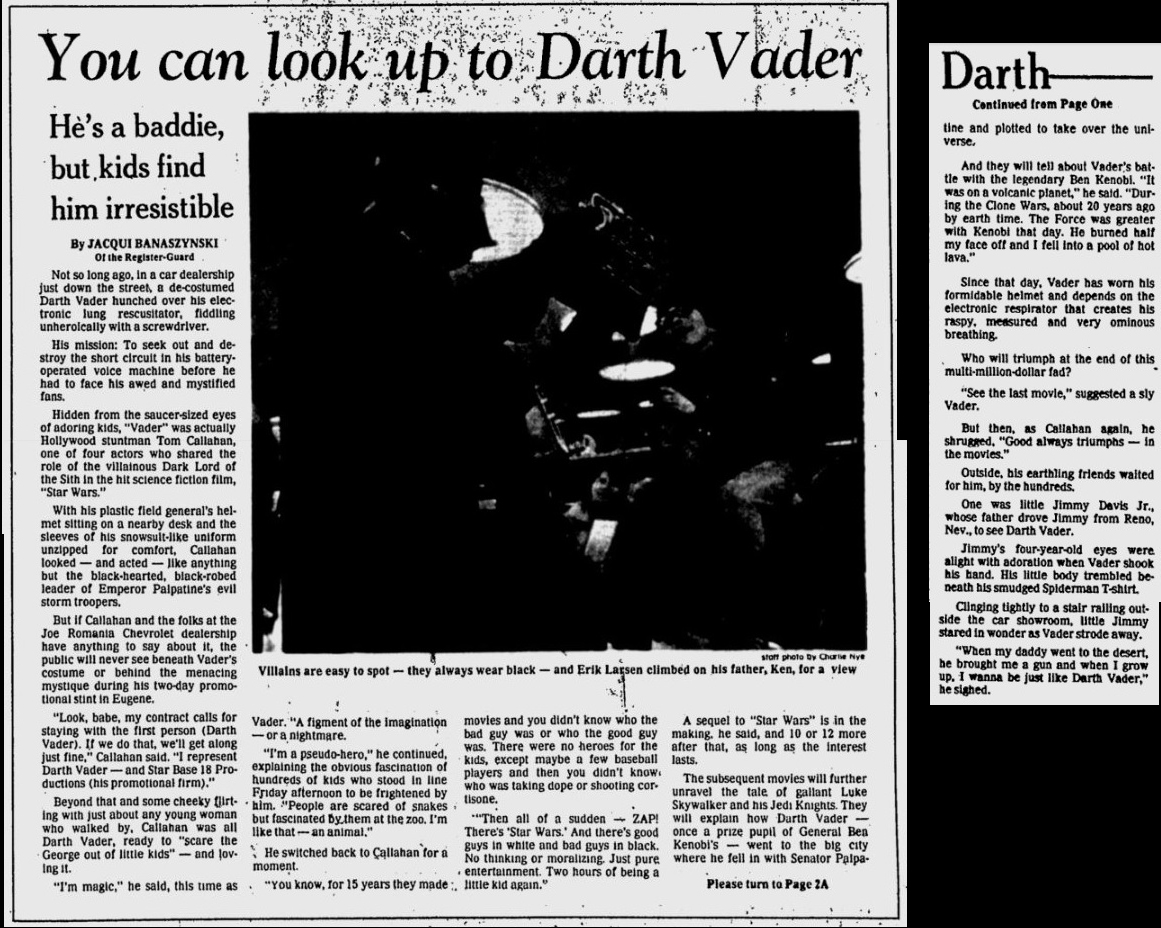
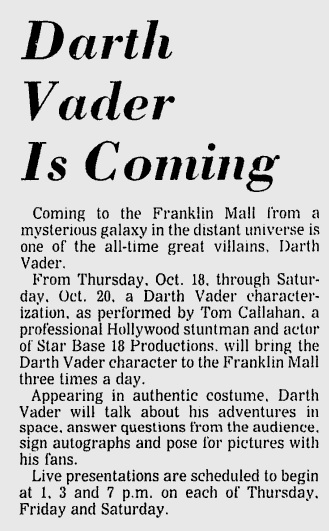
Actual ad for one of Tom Callahan's appearances as Darth Vader.
Graham v. Callahan (1984 Tenn. App. LEXIS 3235): A case
concerning an injury which took place during a personal appearance by
"Darth Vader" at a mall Tennessee.
"The Defendant, Tom Callahan, is a professional en-tertainer
[sic] who characterizes Darth Vader. The
Defend-ant-Appellee is the booking agent for Callahan and en-tered [sic] into a contract on his behalf with the Defendant,
Cleveland Mall Merchants Association, for him to per-form at the Cleveland Mall
on July 28 and 29, 1980. Callahan's
performance apparently included an act in which he would swing a sword over and
around the body of a volunteer from the audience [sic]. On July 29 Plaintiff Joyce Graham volunteered
to participate in the performance
with Callahan and in the course of the act she was struck on the side of the
head with the flat side of the sword, resulting in personal injuries."
The court ultimately rules that
the booking agent could not be held liable for the injuries, based on the fact
that the booking agency did not have the power contractually to control what
the actor did on stage during his performances.
For those interested, I actually found a couple other articles on Tom Callahan's personal appearances as Darth Vader and have placed them in the SWCA Newsstand:
You Can Look up to Darth Vader
Darth Vader is Coming
Anthony v. Mazon (2006 Cal. App. Unpub. LEXIS 5625): A
case related to a divorce preceding. The
judge is so angry with the parties behavior before trial that he notes,
"This case is somewhat akin to deciding a dispute between Darth Vader and
the Borg....".
CPG Products Corp. v.
Mego Corp. (1981 U.S. Dist. LEXIS 17657): A case dealing with Kenner's Stretch Armstrong toys. Apparently, Kenner believed that Mego
had misappropriated Kenner's trade secrets in the design and manufacturing
processes behind the Stretch Armstrong doll, in order to make their own line of
stretch toys based on comic book characters.
"The doll, which Kenner Products Division began marketing in 1976, is an elastic toy filled with concentrated corn syrup which can be stretched or moved from one position to another, and, when released, will slowly return to its original shape or position as the elastic skin reacts against the highly viscous filler. Kenner marketed these toys, known as "Stretch Armstrong," "Stretch Monster," "Stretch Octopus," "Stretch Serpent," and "Stretch X-Ray," from June 1976 to January 1979. The toy was extremely successful commercially, accounting for sales of over fifty million dollars during that period. Kenner manufactured these dolls through late 1979 and still offered them for sale in its 1980 catalogue, but it has since discontinued sales of these items."
But there were soon other companies in the stretch toy business:
"In April 1979, Mego began marketing a line of elastic toy dolls which also consisted of shaped, stretchable skins filled with a concentrated corn syrup. Mego's dolls were marketed in two categories: large dolls the same size as Kenner's, known as 'Elastic Hulk,' 'Elastic Superman,' 'Elastic Plasticman,' and 'Elastic spiderman,' and, beginning in the Spring of 1980, smaller dolls in the figures of elastic Disney characters and 'Elastic Casper,' Through July 1980, Mego's net profit on these items has been in excess of [specifics deleted]."
The court then launches into a brief history of the toys themselves:
"The original idea for Kenner's stretchable doll figures was conceived by a CPG employee named James O. Kuhn in January 1974. He developed his idea through experimentation and design until he was able to present a prototype of the figure to Kenner for evaluation in February 1975. Kenner accepted the item for commercial development and began working on the process by which it could manufacture such figures on a mass production scale in March 1975.
Kenner's first consideration was to find a process by which it could concentrate the corn syrup filler in its commercial manufacturing process to get the desired feel and play value for the doll. Kenner personnel experimented with Kenner then narrowed its search to two suppliers, thoroughly evaluating one before finally settling on. Then, once a decision was made to use a particular model, Kenner worked further with the supplier to modify that model so that it would handle the particular requirements of Kenner's manufacturing process which involved the stretch figures.
Another major area of process design and development at Kenner involved the selection of equipment and procedures for filling the skins with the concentrated corn syrup. Again, after much consideration and evaluation, Kenner selected [specifics deleted] as its supplier of filler equipment. In conjunction with the filling process, Kenner decided to use a [specifics deleted]. Thus, the development of Kenner's doll and its commercial manufacturing process, from the inception of the idea to actual commercial production, covered a period of two-and-a half years. January 1974 to June 1976.
Although it took Kenner approximately two-and-a-half years from conception of the idea for the elastic toy until its actual production, it was only eleven months, from July of 1975 until June of 1976, that it took Kenner to develop and implement the production line. Mr. James Wright, the project engineer assigned by Kenner to commercially develop the elastic figure began to investigate the uses of [specifics deleted]."
In essence, Kenner is saying that this process is a trade secret and wants the court to stop Mego from using it for other toys. In return:
"Mego asserts that most of the individual components of Kenner's production line were standard equipment, and that information concerning this equipment which Kenner applied to its design and production problems in its commercial manufacture of its stretch dolls was available from sources outside Kenner. Therefore, Mego argues that these items individually or in combination did not rise to the level of trade secrets."
The court agrees with Kenner and stops Mego from exporting these secrets. To me, what's most interesting about the case is how cloak and dagger everything is. Sections of the decision are redacted (I assume to hide these secrets from the public) and the engineers even use code names ("Mr. X") while talking with Mego about the process, etc. Funny to think that a rubber sleeve filled with corn syrup could cause so many problems.
Are the two stories interchangeable?
Zambito v. Paramount
Pictures, Corp. (613 F. Supp. 1107) 1985: This case is technically outside our mandate, in that it concerns something unrelated to Star Wars and Kenner. It does however deal with Indiana Jones, so I think it counts.
In this case, a screenwriter is claiming that "Raiders of the Lost Ark" is a
copyright infringement of his earlier screenplay "Black
Rainbow." The court gives a
synopsis of "Black Rainbow," which I'll
include here:
"Plaintiff's screenplay, 'Black Rainbow,' is the story of
archaeologist Zeke Banarro's ('Zeke') expedition to the Andes of Peru
in search of pre-Columbian gold artifacts. In the preamble to
'Rainbow,' Zeke is introduced as 'a legitimate archaeologist who
became a renegade treasure hunter or huaquero.'
In the opening scene, Zeke is informed by his former lover,
Michael Colby, a female museum curator, that Zeke has been replaced as head of
an expedition to Peru. Undaunted, Zeke finances his own 'bootleg'
expedition with the help of a
cocaine dealer who fronts Zeke the money in exchange for Zeke's promise to
smuggle cocaine from Peru.
Upon arrival in Peru, Zeke and his sidekick, Justo, a
Peruvian Indian native, pause to taste the pleasures of cocaine and
prostitutes. After assembling an entourage of Indian natives and taking as a
partner, Alvarado, who supplied horses and pack animals, the party then
proceeds on the expedition.
Along the way, Tumba, Alvarado's servant/mistress, gives
birth to a son. Shortly thereafter,
Alvarado offers Tumba's services as a prostitute in return for the other
Indians' share of the treasure. Zeke seeks to prevent this exploitation by
pacifying the natives with cocaine. Ironically, Tumba, who is understandably
grateful for this act of humanity, rewards Zeke with sexual favors.
Later, an old Indian mystic tells Zeke that he can locate
the cave with the great anaconda snakes, and hopefully the treasure, by
observing the reflection of the sun off the side of the cliffs. Upon locating
the cave, the party rappels [sic] down the side of the cliff, fights off the
anacondas with molotov cocktails, and uncovers the treasure in a burial site
inside the cave.
As they are about to
begin their trek back from the clifftop, the expedition is confronted by the
script's principal antagonist, Von Stroessner, and his band of thieves. As it
turns out, Von Stroessner was hired by Michael Colby and the museum to follow
Zeke and liberate him of his new-found treasure. A fight ensues, in which Zeke
and Von Stroessner are wounded and several Indians are killed. Zeke ultimately
shoots Von Stroessner in cold blood.
The expedition
party continues the journey back, only to be confronted by the Peruvian
National Guard. In the ensuing gunfire, Justo is mortally wounded, the
remaining Indians are killed, and Zeke and Alvarado are forced to flee through
the dense jungle carrying what little gold they can carry. Zeke ultimately shoots Alvarado in a quarrel
over the remaining treasure, and the story ends with Zeke hiking back to
civilization."
So, what do we think? Does that sound like Raiders of the Lost Ark? The court isn't so sure. They argue that the tone of the two films is entirely different:
"'Rainbow' is, for the most part, a somber, vulgar
script replete with overt sexual scenes, cocaine smuggling and cold-blooded
killing. 'Raiders,' on the other hand, is a tongue-in-cheek,
action-packed, Jack Armstrong, all-American adventure story."
The screenwriter says that there are numerous similarities though, far more than could be coincidental. The court then responds to this argument:
"Plaintiff argues, initially, that actionable similarity lies
between the two protagonists, Zeke Banarro and Indiana Jones. Any similarity
ends, however, with the fact that both are male and both are archaeologists.
Zeke is basically a serious, self-interested, individual who betrays both the
museum for which he works and his illegitimate 'backer,' strikes out
on his own, and ends up shooting his adversaries in cold-blood. Indy, on the
other hand, is a larger-than-life adventurer who, in matinee-idol fashion,
remains loyal to truth, justice and the American way."
The screenwriter believes that the similarities are bigger than just the main characters though, and includes supporting characters and scenes as well.
"Finally, and incredibly, plaintiff asserts a similarity
between Marion Ravenwood of "Raiders" and a combination of Tumba, the
pregnant Indian mistress, and Michael Colby, the ambitious museum curator, of 'Rainbow.' The only similarities between these characters, however,
are that they are female and that they share the common experience of a sexual
encounter with the respective protagonists."
The court doesn't seem swayed by this argument and shoots it down. Ultimately, the court decides that the case isn't actionable:
"Upon close inspection, plaintiff's remaining claims of
actionable similarity fall within the category of unprotectible scenes a faire.
That treasure might be hidden in a cave inhabitated by snakes, that fire might
be used to repel the snakes, that birds might frighten an intruder in the
jungle, and that a weary traveler might seek solace in a tavern, all are
indispensable elements to the treatment of 'Raiders''
theme, and are, as a matter of law, simply too general to be
protectable."
Personally, I'm having a rather hard time imagining Indy and Satipo pausing at the beginning of Raiders for a cocaine and hookers break. Maybe in a ROTLA Special Edition though. :-)