Saturday, January 2, 2016

Back to the Drawing Board:
The Pre-Production Process of a Star Wars Greeting Card


Tommy writes:

Back in the days before text messages and Facebook IMs, people kept in contact with distant family and friends through magical things called "letters." If you were willing to spend a few dollars, you could even buy a special type of letter, called a Star Wars greeting card, which came pre-printed with an image of Star Wars characters and a generic greeting inside, because no one ever knew what to write in them.

Okay, I'm kidding... kinda. While perhaps not as popular as they once were, greeting cards are still a huge business and I think everyone has sent or received them at one time or another. There have been dozens and dozens of Star Wars greeting cards over the years, released by a number of different companies. Funny cards, meaningful cards, romantic cards, you name it. Released for every holiday and occasion, in a rainbow of colors.

As with all things however, these cards did not spring fully-formed onto store shelves. They had to be created by artists and printing professionals, all of whom were trying to make something that you'd want to send out to your loved one as an expression of the sentiment you were feeling. They needed to write your own words for you and present them in a way that made you want to pay them for it. As such, the people responsible for these cards needed to be at the top of their game, and the process they used to create the final cards is a complex one.

With that in mind, I now present the complete design process of the vintage Star Wars greeting cards released by Drawing Board, showing (almost) every stage of how they were created.

Specification Sheet
Creative Specification Sheet:
 
Our greeting card begins here, with this creative specification sheet dated October 1978, which seems to amount to a work order. It is the management of Drawing Board telling its artist what to paint and why. In this case, they are telling Mary Grace (the artist responsible for many of the vintage Star Wars greeting cards) that she needs to paint a C-3PO and R2-D2 card. They provide her the size it needs to be and the type of stock the final card will be printed on.

Now, I'm assuming that she would need to present them with some kind of thumbnail sketch of her idea as to pose and layout, but that seems to have been done more in a meeting setting rather than in a formal step. I have never seen any kind of rough or preliminary for these cards, despite there being examples of every other stage around. As such, I assume it's either that the approval step was more casual or perhaps the artist simply didn't paint that way and instead chose to present her bosses the finished art for their approval.

Original art with clear transparency in place
Original Art:

Once the artist has the specification sheet in hand, they can begin to work on the actual art for the cardback. Here, the artist has rendered a very nice image of R2 and 3PO.

Original art with the clear transparency removed
The art is actually done as two separate elements, with the painted details laid down under a clear sheet containing all of the black lines, rather like an animation sheet. This ensures that the edges and colors all remain clear and bright.

Mechanical layouts for the back and interior of the card
Mechanicals:

The artwork is not the only thing printed on the card however, so the printer needs to produce these mechanicals for the inside and back of the card. You can think think of them as a layout for the design, featuring elements hand-pasted onto the board and the proposed outline of the finished card once its die-cut penciled in, showing where everything needs to go. This helps guide the printer and ensues that there aren't any mistakes when the card goes to press, since it's already all planned out.  

You can see that our card is destined to be a "get well" card, and it's at this stage that the greeting inside is finalized. On some cards, this decision was made on the design specification stage, but with this particular example, it appears they decided the greeting after the art was already finalized.

Films:

We are missing a stage here. The printer would use the art to create films/separation sheets, which are transparent sheets showing where each color on the finished card needs to go. So, for example, there would be a sheet simply showing everything that's blue on the card and nothing else, and a sheet showing everything that's yellow, and so on. The 4-color printing process needs to lay down each color in turn, producing the final image once the card went to press, so each color is planned separately. The films create the plates, which did the actual printing. None of the films have ever turned up however.

Blueline (front)
Blueline:

Once the films are created, they are proofed using a blueline. A more inexpensive form of proofing than Cromalins, the blueline is simply showing all of the colors on the card in various shades of blue. The primary purpose of the blueline would be to check things like registration and to ensure that the films do not contain imperfections or create bleed. In other words, it is used to spot big problems. You can see that the printer has circled a number of issues with the films, indicating what needs to be fixed before the card goes to press.

Blueline (back)

The blueline is actually double-sided, the back showing what the interior of the card will look like.

Cromalin Mock-up
Cromalin Mock-up:

This is an odd stage and I'm not entirely certain what's going on here. For ease of identification, I'm going to call it a Cromalin mock-up, but that's not actually the purpose it's serving. The printer has created a Cromalin of the art (a term I will define in a moment), but they've done it in two pieces again.

Cromalin mock-up without overlay
So, the Cromalin is actually only of the color portion, and the black lines are once again on a clear sheet and are removable. I assume that the printer was concerned about keeping the colors as bright as possible and the black lines crisp. Creating a Cromalin of the colors as a separate entity would allow them to make changes to them without affecting the crispness of the black lines.

The exact purpose of the stage remains a bit of a mystery though, in that there is also a tracing paper overlay, showing odd blocks penciled onto it. I believe that it has something to do with translating the 2D image onto the embossing dies, as other examples I have of this stage for other cards are marked as being "Multi-Level Embossing Die SS," but I'm not sure what that means. I would guess that they wanted to see the black lines and the colors as two different elements, since the black lines would delineate which details would need to be raised on the final card and which would remain flat.

If you want to hazard a guess as to the actual purpose though, feel free to drop me a line in the comments section.

Cromalins for the front of the card
Cromalin for front and back of card

Cromalins:

Once their mock-up stage has served whatever purpose they had for it, the printer can start to finalize color correction and continue the proofing process. As we saw in my article about creating an action figure, Cromalins allow the printer to do color management and correction, in addition to simply checking that everything is as it should be. In other words, they are used to spot smaller issues with the films than would be evident on the blueline. Cromalins are one-sided and printed on slick photo-like paper, which allows for very vibrant colors. In stark contrast to the cheaper bluelines, Cromalins are expensive to produce.

Here we can see they started out printing just the front of the cards, even making a mistake and printing one of them as a mirror image. A later example shows the front and back of the card.

Printing Plate:
 
Once the Cromalins were used to proof the films, the final printing plates would be created and the printing process could begin. None of the plates used to print the Star Wars greeting cards have ever turned up.

Proof
Proof:

Once the printing plate was created, they could start producing proofs to test them. You can see the color bars at the top, used by the printer to keep track of the colors and to make sure all of them are printing correctly. He has written in some notes on the colors, indicating changes to the intensity which need to be made before the final cards are produced.

This proof is essentially a card which was never die-cut, although the message inside (which Drawing Board calls "the sentiment") is not printed on the reverse of this sheet. The printer has written in a notation that the sentiment is on the Delux (which I assume is the Cromalin stage) however and needs to be checked before the card goes to press.


Embossing tests
Embossing:

It should be remembered that the card still needed to be embossed however, so that all of the details of the droids would be three-dimensional.

Typically, the embossing process involves the creation of dies showing the image of the final card and the desired 3D details. On one of the die, the details are raised and on the other, they are recessed. These sheets of paper were then pressed between the dies as a test. The raised details on one die pushed the paper into the cavities of the other die, creating the embossed effect. Once the samples were approved, this process could be repeated and production of the embossed cards commenced.

Sadly, the embossing dies themselves have never turned up.

Die-Cutting:

The last stage in our process would be to run our printed and embossed cards through a die-cutter. The process (sometimes called "dinking") is essentially like an ordinary office hole punch, but instead of being round, in this case it's shaped like 3PO and R2.

The uncut cards go into the machine, where a rotary die (a cylinder with a raised cutting edge in the shape of the outline we want) is slowly turning. The paper passes beneath the turning rotary die, and the shaped blade is pressed down onto the card, cutting away the excess paper like a cookie cutter as it rolls over the card. Since the only thing touching the cardstock is the sharp edge of the die, the embossing is not affected by the process.

Technically, I suppose you could do the dinking (and yes, I'm using that term simply because it makes me giggle like a schoolgirl) before the embossing, but given the fact that the embossing samples are not die-cut, that doesn't appear to be how Drawing Board did things. That's purely conjectural on my part though, I've never confirmed it with anyone at the company. 

In either case, the rotary dies used in the creation of the vintage Star Wars greeting cards have never turned up.

Company storage envelope
Envelope:

The various stages of this card were transported around the company in a special envelope, showing what the card looked like and giving its internal product number. This ensured that everything stayed together, should the company ever need it again, and that none of it was lost as it was passed between departments during the production process.

Final greeting card
Final Card:

Here we see the end result, the final embossed and die-cut C-3PO and R2 get well card.

Mobile mechanical
Mobile Mechanical:

It should also be noted that Drawing Board was so happy with the design of this particular card, that they used it as one of the danglers on their display mobile, which hung in stores to advertise their cards. Here we see a mechanical for the project, telling the printer how to alter the greeting card so that it could be used for a new purpose.


Drawing Board greeting card store display mobile
Mobile:
 
Here's the final mobile, showing the recycled image from this card.

The other cards on the mobile went through the exact same process as this card. In fact, I have the matching production run of the Stormtrooper card. Drawing Board was very good at saving their work and I've managed to collect pre-production series of several different greeting cards now and am always looking for more.

And so, there you have it. Everything that goes into making a greeting card. As you can see, it's not a simple process and it requires a lot of different stages to get right. Next time you walk past racks of greeting cards in a store, just think of the hundreds of man-hours represented in those simple folded pieces of paper.

Thanks to Tracey Hamilton and Ron Salvatore for helping me to figure out what some of these stages are, and to Todd Chamberlain for the image of the mobile.

Monday, December 28, 2015

A New High - Holiday 2015 MarketWatch

Pete writes:

Happy Holidays Space Freaks!

We’re back in the swing of things with our monthly MarketWatch update on the Star Wars Collectors Archive. So much is going on in the hobby these days it’s hard to stay on top of everything. One thing that is apparent for anyone following eBay, Facebook or even those still on RebelScum is that the market is at an all-time peak. Items have reached phenomenal heights, and not just online but at shows across the globe. The season of Star Wars is upon us, from toy shows, to big finds and everything in between the excitement of The Force Awakens has captivated collectors and casual fans alike as the anticipation for the newest installment of the saga has people across the world rejoicing for the return of Star Wars

This season we’re going to hone in on some impressive auctions from the last 60 days -- some rarer than others but all impressive in their own right.  

Before we get into the auctions themselves, I felt it was appropriate to take a moment and address where prices are in the hobby today and over the last year. A lot of collectors are very bullish on the market, feeling that the movie will lead to a new era of high prices and growth in the value of their collections. This feeling is not unwarranted, however I think that all collectors need to take the current trends as just that, current trends. We’re seeing phenomenal peaks in the hobby these days, but the question of sustainability of these prices is something that all collectors should ask themselves given results have been mixed in some cases, especially on eBay leading into the holidays.  

This year I was able to travel a lot more than in year’s past and was able to attend several events, from Wizard World Comicons, to Star Wars Celebration and even the Cincinnati Toy Show. Every venue has something different to offer, but the one thing that is consistent at them all is die hard collectors. Excitement has been high all year with our brothers and sisters in the hobby, and you see everywhere you go. Along with spirits being high at each event, one other thing is very consistent: a dialogue about how difficult it’s become to find items. Collectors are holding onto more than in the past and it’s leading to a deficit in the amount of high end items available. In a sense the hobby is very healthy, however the scarcity of certain items is leaving some frustrated and driving up the price of items that really aren’t that rare. 

The core concept of supply and demand is really the underlying reason for a great deal of price appreciation in the hobby. Supply is at an all-time low, thus demand is at an all-time high. Sprinkle in the excitement of a new movie and a ton of media coverage in the hobby and you have the perfect storm. Thus, as we enter an era of a great new movie, an era of new blood in the hobby and an era of a new peaks in pricing, if one thing is certain, it’s that it the rare pieces will keep getting tougher to find, and the spirit of competition among collectors will continue to evolve.

Between $13,000 and $16,000 original buy it now pricing = $25,000

Although many segments of the hobby haven’t kept pace with the prices that we’ve seen in the action figure segment, one that is considered by many to be a “fringe part of the hobby” has kept pace right along the Vintage Kenner toy line are the Power of the Force coins. The segment that is considered by many to be one of the most frustrating areas to collect in has seen incredible prices over the last year. 

The core goal of many is to complete the 62 coin set, and from what I’ve seen and heard this quest has one of the highest abandonment rates of any run in the hobby today. This is mostly due to the fact that the Category 4 and 5 coins represent such a small portion of the overall availability and demand incredibly high prices, with coins like the Sail Skiff seeing prices over $1,500 in the last year. Given this, several collectors have taken the route of buying a complete set and saving themselves the headache of years of time and angst piecing together the run.

In our first auction we have someone that has elected to do just that. This 62 piece collection of the POTF coins is most impressive. With an initial listing price of $25K it may have seemed daunting and overpriced, however someone was able to work this individual down to a price of between $13 and $16K. Given where the market has been on individual coins over the last year we can come to the conclusion that if all were available it would cost someone roughly $16-20K to put together a set, a move like would save a lot of time and overall investment into the set itself.   


Vinyl Cape Jawa - $11,750

When it comes to 12 Backs there are so few pieces that are truly rare by definition. In fact when it comes to MOC figures from Star Wars the first 21 are some of the most common. Double-telescoping lightsaber figures are on one end of the spectrum, and just down the road is this little guy the Vinyl Cape Jawa. Averaging a price 10 times that of most 12 Back figures, he is one of the most difficult to find and by comparison to the others is actually rare vs. just sought after. This Jawa is a great example of just how much prices have appreciated in the past year. Selling consistently for $6 to $8K last year, it’s hard to fathom what impact one year has made on the going price.


POTFYak Face MOC - $8,400


Our next two figures are staples of rarity and high prices in the hobby. Yak Face and Anakin Skywalker were only released in a few countries on a POTF cardback. Although a loose Anakin is fairly common given the mail away promotion for the figure, a loose Yak Face can command upwards of $450 these days. Think that’s crazy? Well, just the coins for these figures have gone through the roof in the last year with an Anakin coin commanding $2-300 and a Yak Face coin averaging around $500. Taking into consideration that the loose components are roughly $950 it’s easy to see that a good condition carded example is way up there in terms of price.

Both figures support the notion that prices have hit a new peak as these figures have never seen these types of prices in the past.   However crazy, they are a few of the rarer figures when you look at the line in totality and coming in with an AFA75 and an AFA…shows that collectors will continue to shell out large wads of money to for something that is in good shape.


Growth is at the core of the discussion this month, specially focusing in on price and value growth in the hobby. But it can’t just be measured by dollars and cents. For many long time collectors, growth is about expanding into new territories and new segments of the hobby. In the 2000s pre-production in the form of proof cards was an expanding area, in the last 5-6 years catalog mailers have taken off in popularity, and more recently store displays have gone from a niche to mainstream in our hobby.

The array of different store displays out there is pretty impressive. From backers to shelf talkers to hanging displays, there’s plenty to keep collectors busy. Unlike most segments, these items were thrown away more than they were kept, making finding them a fairly interesting task. Regardless the numbers of displays and portions of displays that survived is fairly staggering, however the frequency of their availability on the open market is something completely different. Thus when something comes up it usually commands a high price, and when something ultra rare comes up, the prices go through the roof. Such is the case with the item at hand -- the backer for a bin of figures used in certain mass retail channels. Very few have survived and if you had any interest in getting one, this was a rare chance to jump on it.      


Our next item is a unique piece unto itself. Display stands were not a very successful segment of the toy line, and by the end of the ESB run these items were taken out of the core toy assortment. The ESB version of the display stand was Kenner's last attempt to get people to spend a few more dollars on a piece of plastic with a simple backer and sticker package. They put all their irons in the fire with this one, bringing 6 figures into the mix, and because of this it's one of the most sought after display stands in the hobby. 

It's rare, and it has demand, and as anyone can see from the price you need to drop a lot of cash in order to find one. It's a great piece for any collector, but in this case I have to say it went for a lot more then it's worth, given it's open, and all but one figure has been taken out of it's baggie. Nevertheless it's a crazy market and I'm sure someone who needed this was more then willing to dish out the cash to find it.


This month we saved what might be considered the best for last. 

When it comes to things appreciating in price in a hobby there is always a segment that over performs vs. the norm. It’s a function of demand, the thing that differentiates the mundane from the majestic. In the world of Vintage Star Wars no other segment has seen as quick and as consistent an increase in prices as the Star Wars and Empire Strikes Back window box 3 Pack Sets. Theses sets have always been some of the most sought after production pieces in the Vintage line. With the situation we’re seeing over the past year, these have become truly expensive on a whole new level. Whereas one could buy a Creatures Set or Droids Set in the last few years for around $1,500, the sets are going for nearly $5K today.  Thus it shouldn’t have surprised anyone to see Brian’s Toys sell an ESB Imperial Set on Cyber Monday for over $9,000.  

With a strong grade and being a mid-tiered piece in terms of rarity to the rest of the line, the ending price was in line with what one should expect to pay today. Whereas a few years ago you could put the run together for $80-$100K, some sets in today’s market on the rare side of the scale sell for upwards $30,000 on their own (for high grade examples).  


That’s it for this edition of the MarketWatch, thanks for another great year! 

We’ll be back in February with our post-Holiday round up of the market.

Wampa Wampa!
(Fratastic) Pete

Friday, December 25, 2015

Star Wars Christmas Roundup 2015

Amy writes:

If you haven't realized by now, I'm a sucker for seasonal Star Wars items. This especially applies to Christmas items. I thought I'd share some of the most awesome seasonal Star Wars items the galaxy has to offer us this year.

Worry no longer! Christmas In The Stars, the definitive (and thankfully only) Star Wars Christmas album is finally in print again. It was re-released by Amazon just in time for the holiday. This version is meant to emulate the origional LP recording and includes a 'record sleeve' for your CD with the origional RSO label design.


Wandering around the stores this year, Hallmark had a few new offerings beyond the annual holiday ornaments. This year Itty Bittys came with holiday garb. Available were fan favorites Chewbacca, Yoda, R2D2, and C3PO. As an added bonus, proceeds benefit Toys For Tots.


Santa Yoda offerings this year included a mini stocking from Target and a bizarre 'didn't know I needed it but so happy they made it' mini lunchbox gift card holder. It has the added surprise of Yoda telling your fortune!


Finally,  I did add this lovely vintage find, a Chewbacca Christmas card by Drawing Board.


The inscription is the best part!


'Till next year, Santa Ewok and I wish you Happy Holidays and a Star Wars filled New Year!

Thursday, December 24, 2015

'Chive Cast 68 - Top 10 Vintage Winners & Losers from
The Force Awakens


It’s a Force Awakens Response Podcast, from a Vintage point of view. Skye and Steve talk about their thoughts and reactions and break down the 10 biggest winners and losers among Vintage Star Wars items. It’s another unusual podcast, but its not like these movies come out every month! Caution. Henceforth, there will nothing but spoilers! Who wins? Who loses? Listen to the newest ‘Chive Cast Vintage Pod to find out.


Loading the player...

DIRECT LINK DOWNLOAD

Tuesday, December 22, 2015

Revell Reveals More The Force Awakens Models!

Tommy and Yehuda write:

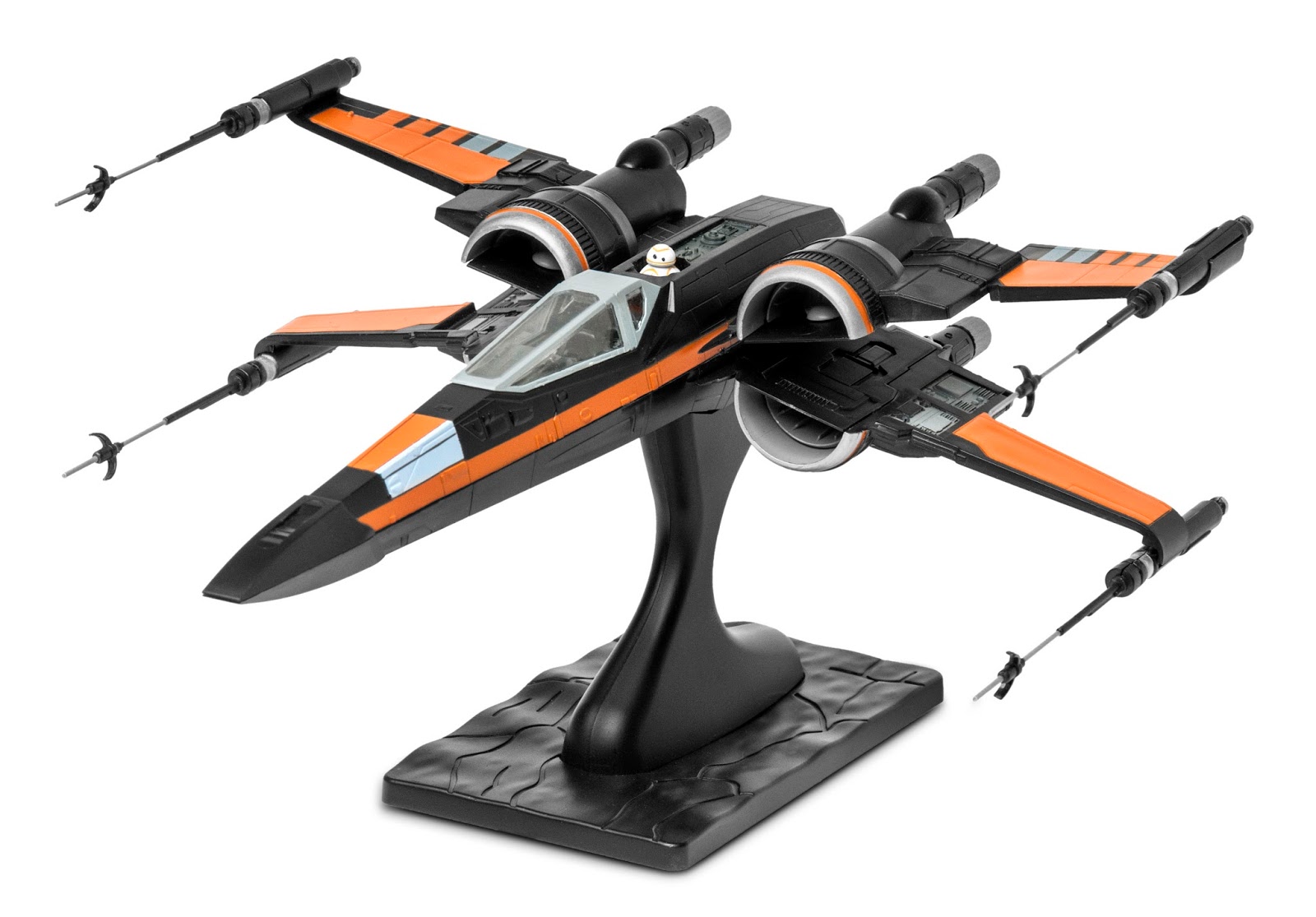
Revell models has had a busy week. Having already revealed their new Master Series of models, they also sent us pictures of their next assortment of models: SnapTite Max. These are more complicated than their first series of SnapTite models and are aimed at a slightly more experienced model builder. 

We really like this line. It's a nice compromise between the ease of assembly found on the first series of SnapTite models, but with more detail. Additionally, it doesn't require the time or expense of the Master Series of models.  
First Order Special Forces TIE Fighter SnapTite Max model
Kylo Ren's Command Shuttle SnapTite Max model

Millennium Falcon SnapTite Max model

Poe's X-Wing SnapTite Max model

Resistance X-Wing SnapTite Max model
For Intermediate Builders:
The five new SnapTite® Max™ models replicating the vehicles in Episode VII of Star Wars enable builders ages 8+ to construct detailed, real-world renditions of the Millennium Falcon™, Poe’s X-Wing Fighter™, Resistance X-Wing Fighter™, First Order Special Forces Tie Fighter™ and Kylo Ren’s Command Shuttle™ from the new movie. Each Skill Level 2 kit features 39 to 85 pre-decorated, snap-together pieces that can be assembled in an hour with no need for paint or glue while providing a more challenging project as compared to the SnapTite Build & Play line.

The finished SnapTite Max models are significantly larger and more detailed than the SnapTite® Build & Play™ kits designed for younger children, thanks to higher piece counts that allow more details to be molded into the plastic. Assembled sizes range from 10” x 8.8” for the X-Wing Fighters to 14” x 10” for the Millennium Falcon™. All five also have moving parts like open/close cockpit hatches, removable landing gear and wings that open into attack mode – to better replicate the epic battles taking place in a galaxy far, far away.

Availability:
The new SnapTite Max kits are available at Hobby Lobby stores and online. Prices range from $29.99 to $69.99.

Monday, December 21, 2015

Star Wars at the Movies: One Year Old Today

Ron writes:

Regardless of what you think of The Force Awakens, I think we can all agree on one thing: it won't be in theaters a year from now. Within a few months you'll be watching it on your flat screen while eating C-3PO popcorn and saying something like, "Maybe I wasted my money seeing it in the theater 600 times."

But back in 1977 Star Wars played in some theaters for a full year, all the while racking up box office returns and padding the profits of the Kenner toy company. So important were the toys within the Star Wars ecosystem that the theatrical poster issued to celebrate the one-year anniversary of the movie's release featured Kenner action figures front and center. As far as I know, this is the only time a movie poster has functioned as a de facto toy advertisement.


The poster was printed by Gore Graphics, the company that printed a lot of the posters created for movie studios and the National Screen Service during the '70s and '80s.

Gore also produced ad slicks like the ones you see pictured below. These were sent alongside posters in order to provide theaters with graphical material for use in local print advertising. These slicks are very similar to the "repro art" material that Kenner sent to retailers for the creation of toy advertisements. (I examined some of this material back here.)

A full-page ad.

Once the theater employees were in possession of the slicks, they would clip out the appropriate graphic, modify it with text showing theater name, location, and show times, and purchase space for it in the local paper. Because papers priced ads according to the number of columns (width) and lines (height) they would occupy, the slicks are proportioned in different ways. The largest, comprising six full columns and 1200 lines, is equivalent to a full-page ad.

Five-column and three-column ads.

As you can probably tell, the graphic used on the slick is not an exact reproduction of the image on the poster. The background of the slick is white rather than black, and the colors of the cake differ between the two images. 

Four-column and three-column ads.

There are several additional, more subtle differences. My guess is that the image on the slick was created via a combination of photo montage and airbrushing. In other words, it's not a photograph, but rather something assembled by an art department in a manner that ensured it would display well in small, black-and-white reproductions.

Three-column and two-column ads.


Collectors often comment on the absence of the Jawa figure on the poster: Of the first 12 figures issued by Kenner, the Jawa is the only one not represented. While it's tempting to ascribe this absence to the change from a vinyl to a cloth cape that notoriously affected the Jawa, I think it's more likely that the figure's scale and dark coloration simply didn't lend themselves to a balanced composition.

Four-column, three-column, and two-column ads.


Clearly, the designers of the poster reserved the space at the front of the cake for the two droids, Luke, and Leia. The natural space for the Jawa was opposite the Sandperson on the right side of the cake, a distant position that would have rendered it little more than a dark blob on the poster.

Of course, it's also possible the Jawa simply called out sick on the day the photo was taken.


Above you see an example of an actual newspaper ad created using these slicks. I believe it derives from one of the four-column examples, though the image has been downscaled a bit, and the arrangement of some of the textual elements appears to have been tweaked. The ad is for a theater located at the Oakbrook Shopping Center in Illinois.

As is evident from the date written on the ad, it ran in the paper on May 26, 1978. Star Wars debuted in theaters on May 25, 1977.


Here's the reverse of the ad, which almost succeeds in persuading me that it derives from an alternate universe. What is this strange film featuring what I can only assume are the Bad News Tigers? And though I know a fair bit about movies, I've never heard of If Ever I See You Again, which apparently utilized the talents of George Plimpton and featured an erotically charged ice cream cone.

Fortunately, the smaller movie notices mention Brian De Palma's The Fury and a revival of Jason and the Argonauts. We're in the correct universe. Phew.

In "The Star Wars Poster Book," which should occupy a spot in the library of every serious collector, Steve Sansweet and Pete Vilmur explain that the "birthday" poster was "distributed to theaters still showing the film a year after its opening." It's never been clear to me if the "year" in this sentence was calculated from the day on which the specific theater began showing the movie, or from the date on which Star Wars opened in any theater.

The theater in the Oakbrook Shopping Center is not on this list of approximately 40 venues that showed Star Wars on that Memorial Day weekend in 1977. However, several other Chicago-area theaters are on the list, and the Oakbrook location does appear to have been outfitted to show 70mm films with Dolby stereophonic sound, which was a prerequisite for screening Star Wars on its opening weekend.

If anyone knows if Star Wars played at this location between May 25 and 27, 1977, please let us know in the comments.


Here's another example of a "one year old today" ad from an old newspaper. This one was modified heavily from the above slicks; you can even see lines surrounding the main image, indicating that it derives from a mock-up created from elements that were clipped and repositioned. Also, the print quality is quite poor, suggesting it is not a first-generation reproduction.


My favorite thing about the reverse of the ad, aside from the graphic for Convoy, Sam Peckinpah's epic of big-rig truckin' and lovin' on the open highway, is the tagline for the Henry Wrinkler vehicle The One and Only. It's so puzzling that it almost qualifies as a koan. It reads:
He'd do anything for attention. So she had to marry him. She was too embarrassed to have him as a date.
Read it a few times. Tell me those aren't the weirdest three sentences your brain has ever tried to process. She married him to avoid the embarrassment of dating him?

Okay, having gotten that out of the way, we can discuss the date. No, not Winkler's embarrassment date, the release date of the movie. The top of the page reveals that the ad appeared in the paper on October 27, 1978.

"Ah," you're saying to yourself, "this theater must have gotten the movie late!"

Well, sort of.

You see the Hoyts Cinema Centre at 140 Bourke Street wasn't a U.S. theater; it was an Australian theater, located in Melbourne. And Australians didn't get to see Star Wars until it had been out in the States for several months.

Sure enough, IMDb reveals that Star Wars hit Australia on October 27, 1977, exactly one year prior to the date of our ad.

The Cinema Centre was a luxurious movie palace designed with a modernist aesthetic. You can read more about the complex here and here, and you can peruse some of architect Peter Muller's original drawings and models here.

More pertinent to the present topic is the comment of "Snub" in the discussion about the Cinema Centre found here. In it he says, "My favourite memory of the place, along with thousands of others, is the initial engagement of Star Wars that ran for over a year in the building."

There you have it: Firsthand confirmation that Star Wars played in the Cinema Centre for a full year.

Sadly, the Cinema Centre is no more, having been boarded up in the '00s.

One question remains: Was the "birthday" poster ever used in Australia? I would guess not, but I'd love to be proven wrong.